I am a PhD researcher at the Autonomous Learning Robots (ALR) Lab at Karlsruhe Institute of Technology (KIT), supervised by Prof. Gerhard Neumann. My research is part of the RAICAM Marie Skłodowska-Curie doctoral network on Robotics and AI for Critical Asset Monitoring.
I work at the intersection of human–robot interaction and robot learning. I develop interfaces that help people understand a robot’s situation, take control when assistance is needed, and provide corrections that can improve future autonomous behaviour. My work combines extended reality, 3D perception, robot control, and experimental evaluation with human participants.
Within RAICAM, my research concerns semi-autonomous mechanical search: helping robots manipulate objects in clutter and under occlusion, with human guidance when necessary.
Previously, I worked on physical human–robot interaction at Koç University’s Robotics and Mechatronics Laboratory with Prof. Cagatay Basdogan, supported by a KUIS AI Fellowship. I studied Control and Automation Engineering at Istanbul Technical University, graduating as the highest-ranked student in my department.
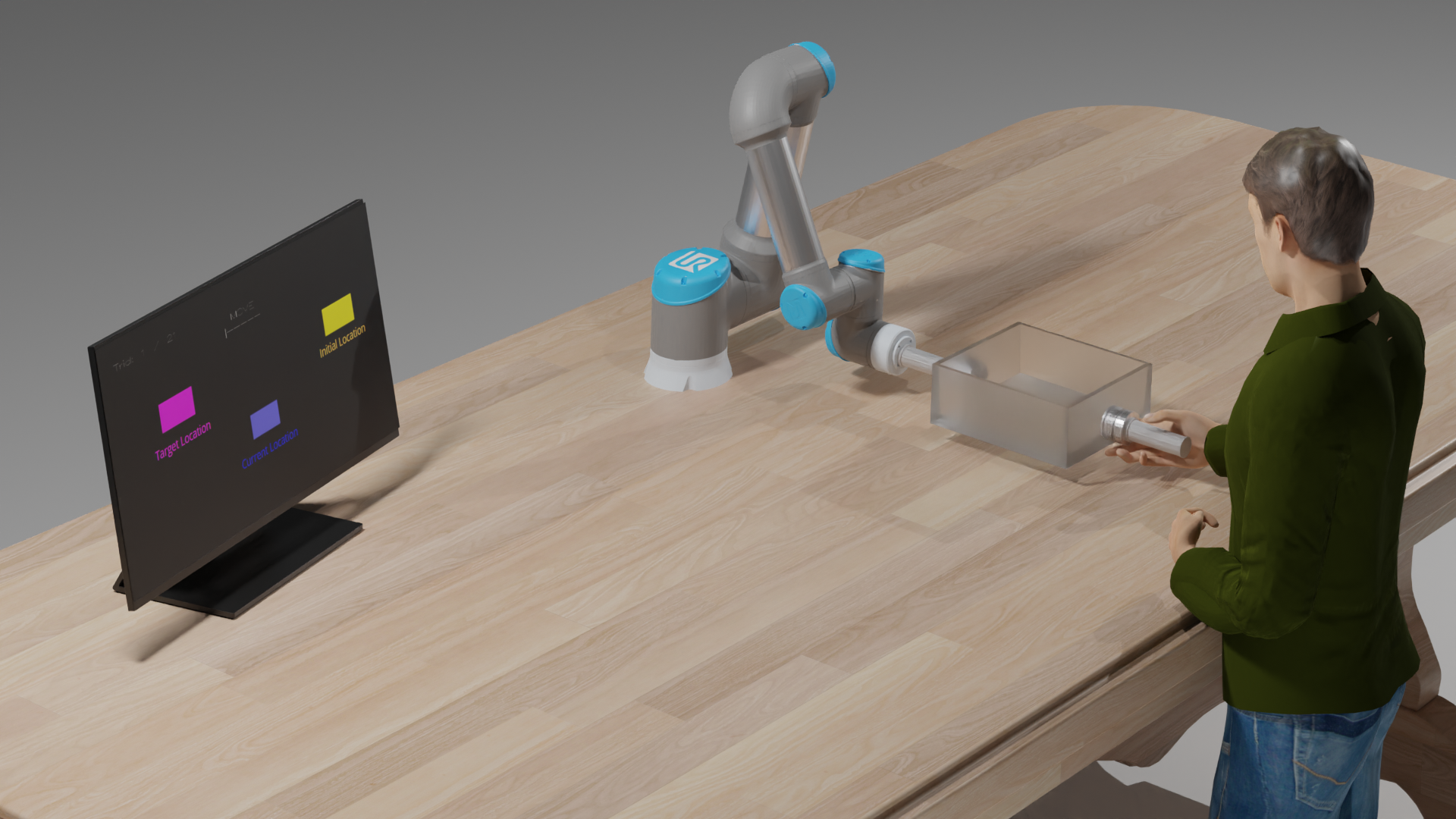
How should people monitor autonomous robots, recognise when help is needed, and intervene effectively? I study visual supervision and corrective control interfaces, including desktop and VR views, point clouds, motion controllers, articulated leader devices, and kinesthetic teaching.
My current work connects these interventions to robot learning: identifying useful human corrections and studying how they can improve a policy’s behaviour.
XR teleoperation and 3D perception
I develop and evaluate immersive interfaces for robot manipulation. My multi-view telepresence work combines fused 3D point clouds with a wrist-camera image to support both spatial understanding and detailed manipulation.
I am a co-author of VLA-FAIL, which studies efficient failure detection for vision-language-action policies. This connects to my broader interest in deciding when autonomous systems need human assistance.
My earlier work investigates conflicts between a person and a robot during co-manipulation. We combine machine learning with admittance control to adapt robot behaviour, and evaluate the relationship between task performance and user preferences.
My undergraduate projects explored robust PID stabilisation and the control of systems with multiplicative uncertainty, including an aircraft longitudinal-control case study.
PhD research · Autonomous Learning Robots Lab Supervisor: Prof. Gerhard Neumann RAICAM Marie Skłodowska-Curie doctoral network
Research in human–robot interaction, extended-reality teleoperation, and learning from human demonstrations and interventions.
Koç University
Mechanical Engineering · Robotics and Mechatronics Supervisor: Prof. Cagatay Basdogan KUIS AI Fellow
Graduate research on conflict detection and resolution in physical human–robot interaction. Teaching experience in dynamic modelling and control and mechanical engineering design.
Istanbul Technical University
BSc in Control and Automation Engineering · 2017–2022 Valedictorian · GPA 3.87/4.00
Studies in control theory, system modelling, and robotics, with undergraduate research in robust control.
Research collaboration and teaching
I collaborate with researchers across the RAICAM network and with KIT’s Institute of Human and Industrial Engineering (IFAB). My research visits include a 2026 secondment at the Italian Institute of Technology (IIT) in Genoa, working on shared control and human intervention.
At KIT, I also contribute to teaching activities, including machine learning assessment. Current student project opportunities are listed on my ALR profile.
Contact
For research discussions and collaborations in human–robot interaction, XR teleoperation, or robot learning, please contact me at enes.dincer@kit.edu.
Autonomous Learning Robots Lab Karlsruhe Institute of Technology Karlsruhe, Germany